On this page I’m collecting some recurring questions and hopefully providing some decent answers.
If you’d like to add a question, please send us a comment at dowtycamino@gmail.com
Pilgrimage?….what’s up with that?
Ancient Pilgrimage
Pilgrimage is as ancient as man. It is as simple as “travelling to a destination with purpose”, typically a spiritual purpose.
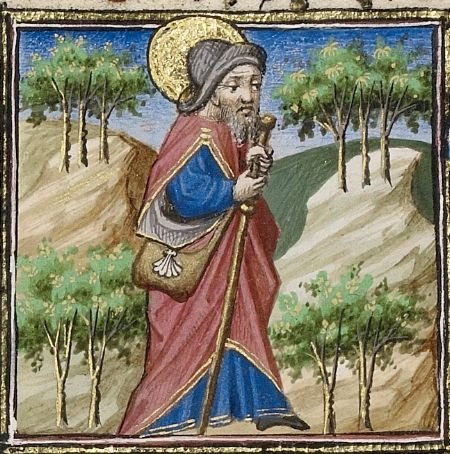
The concept of pilgrimage was massively popular during the middle ages where people, who might typically never travel outside of a few miles away from their birthplace, would pack up their lives and travel to some mysterious remote destination. What were they seeking? It is too simple to say that they were seeking a religious experience or benefit, but that was indeed a popular driver. They might be seeking a physical miracle, or forgiveness of sins through an act of penance. The primary driver was to be near something holy so that you might obtain a closer connection to God.
The primary destinations in the Middle Ages were Jerusalem (the birthplace of Christianity), Rome (the seat of the Catholic church), and Santiago (the reported site of the tomb of St James). Many, many other sites were popular including Canterbury in England.
Getting to Jerusalem was not only dangerous, but expensive. For much of the middle ages, Jerusalem was controlled by Islamic forces who at times welcomed, and at times persecuted Christians.
Rome was a major draw, but Italy as a country didn’t exist. Instead the Italian peninsula was divided up into multiple, often warring kingdoms e.g. Venice, Genova, Florence, Siena, the Papal States, etc. At each border you likely had to pay a toll/tax and there was always the chance that you’d be drafted into the militia to fight against a rival.
Santiago, in comparison, was more freely accessible and, for many, a less expensive destination. At its height, Santiago, as a result, drew up to 500,000 pilgrims a year.
Modern Pilgrimage
To a large degree, as a result of the abuse of Indulgences (earned or purchased forgiveness of sins) within the Catholic church, the Protestant Reformation exploded across Europe. The close link between Pilgrimage and Indulgences caused a backlash against the practice in non-Catholic regions. With the age of Enlightenment, the practice dwindled further until it had practically disappeared altogether.
John Adams (future 2nd American President) walked along the remnants of the Camino de Santiago in the late 1700’s after being stranded in Spain en route to his appointment as ambassador to France. He gave a mostly disparaging account of Spain and the Camino which were both in a state of decay.

The rise of Modernism, Humanitarianism, and Post-Modernism seemed to have sealed the fate of Pilgrimage as a practice.
However in the late 1980’s a Catholic priest Father Elias Valiña, began advocating for the ancient pilgrimage and its cultural and spiritual benefits. He started the effort to re-mark the path with Yellow Arrow that have become a modern symbol of the route across Spain. In 2024, nearly 500,000 pilgrims visited the Santiago de Compostela, a threshold not seen since the height of pilgrimage in the Middle Ages.
Today, people walk for every reason imaginable: spiritual, religious, fitness, adventure, culture, etc.
What is the Camino de Santiago?
The Camino de Santiago is an ancient pilgrimage route to Santiago (St James) Spain. There is a misconception that this most-famous Pilgrimage route, runs only through Spain and Portugal. There is indeed an end point to the Camino (Santiago de Compostela), but there is no true starting point. The starting point for the medieval pilgrim was their front doorstep. As a result, “official” pilgrimage routes extend all throughout Europe. Any route that eventually leads to Santiago is part of the Camino.
The name of these routes changes depending on the home language and custom of the country.
- In Spain they are the Camino de Santiago (The Way of Saint James)
- In France they are the Chemin de Saint Jacques (The Way of Saint James)
- In Switzerland it’s the Via Jacobi (The Way of Saint James)
- In Germany it’s Jakobsweg (Saint James Way)
- In the Czech Republic it is the Svatojakubská cesta (Saint James Way)
“How did you choose your starting point of Prague, Czech Republic?”
- US Citizens are only allowed a 90 day visa in any consecutive 180 days so the longest stay possible is 90 days. For us that is approximately 1200 miles.
- In 2017 we met and have maintained a friendship with two German friends who live in Northwest Bavaria. They’d made the pilgrimage from their home to Sanitago over a few years time. The length of their journey was a major feat that inspired me. In fact, “swinging by” to visit them became a major incentive to start in Western Germany.
- From their village to Santiago is just over 1700 miles so we knew we couldn’t accomplish this in one trip.
- Midway across France is the small village of Le Puy en Velay. Le Puy is a major pilgrimage destination in its own right.
- So we decided to end our voyage at Le Puy en Velay. We attepted to start in Krakow Poland, but Krackow to Le Puy en Velay would be a real stretch and leave no time for rest days or visits with our friends.
- The next major city to the West toward Le Puy is Prague CZ
- So we set our hearts upon Prague to Le Puy en Velay.
“What are those Books that you are getting stamped!”
In the Middle Ages people traveled on Pilgrimage for as many reasons as do modern travelers: spiritual, adventure, profit, etc. But one of the major draws (one that eventually helped spawn the Protestant Reformation and even the Catholic Counter-Reformation) was the potential to receive – upon completion of your Pilgrimage – an indulgence. These were formal recognition of your pilgrimage and fulfillment of an act of penance and basically offered you forgiveness. At first this seems all quite benign. But with humans being what they are, the system was soon corrupted. People would show up at a pilgrim destination and claim they’d arrived on a pilgrimage when in fact they’d walked 5 miles from a nearby village.
So a system was put in place to provide evidence of your journey – the credential. A credential is basically a log of your journey. At each place you stopped the local priest would certify that you’d been through his parish by providing his seal on your credential – sometimes for a fee.
This system was itself rife for abuse of course and forgeries were common. Local taverns and others eager to make a quick ducat got in on the act as well.

The modern credential is still “inspected” upon arrival at Santiago and Rome et al and an indulgence or at least a testimonial is still offered. But mostly these credentials serve their original intent of being a log of your travel told in often beautifully crafted stamps. Along the Spanish Camino each town or church or even bar takes great pride in their stamps.
What is a Pilgrimage church (architecturally)?
As the practice of pilgrimage exploded during the Middle Ages churches offered sanctuary to pilgrims along the way. Some offered “special” attractions such as relics – bits of items deemed to be holy due to their link with a biblical figure or saint. Some of these relics you may recognize and even today understand why people may travel to see them.
For example one church might claim to the burial sight of your patron saint or another claim to have the Holy Grail. Others are more bizarre to our minds – the fingernail of St Bartholomew, or a shoe lace from Peter’s sandal. But all of these relics were venerated and those churches that had particularly noteworthy relics or many of them drew large crowds.
When I say “large” I mean, by-the-thousands..daily. As you can imagine, the church itself had practical problems supporting this number of visitors. Worship services were always interrupted by the throngs of pilgrims wandering through to venerate the relic.
To solve this problem, a main nave was retained, but two additional naves were built to each side. This was common in architecture but a true pilgrimage church took the concept further by extending the side naves up and around the front of the alter such that a one-way path from one entrance to the other was formed. Along this path, side chapels were built to house the relics and offer places of worship.

This a central nave and alter supported the main worship and the throngs of pilgrims could wander in one door and out the next without disturbing the worship of the main body. This circuit was also named the “pilgrimage” of the church as it supported a journey in and through the church in an act of worship.
What photo/video equipment do you use? Is that a drone?
When considering camera equipment it was a balance of three things.
Firstly there is the distraction of having any at all. In many ways I’d like to leave it all behind. There is always a danger of living your pilgrimage behind a lens. I’ve been tempted take nothing but I always chicken out. Too often I’ve been able to re-live a pilgrimage by looking back at my photos. I don’t want to give that up.
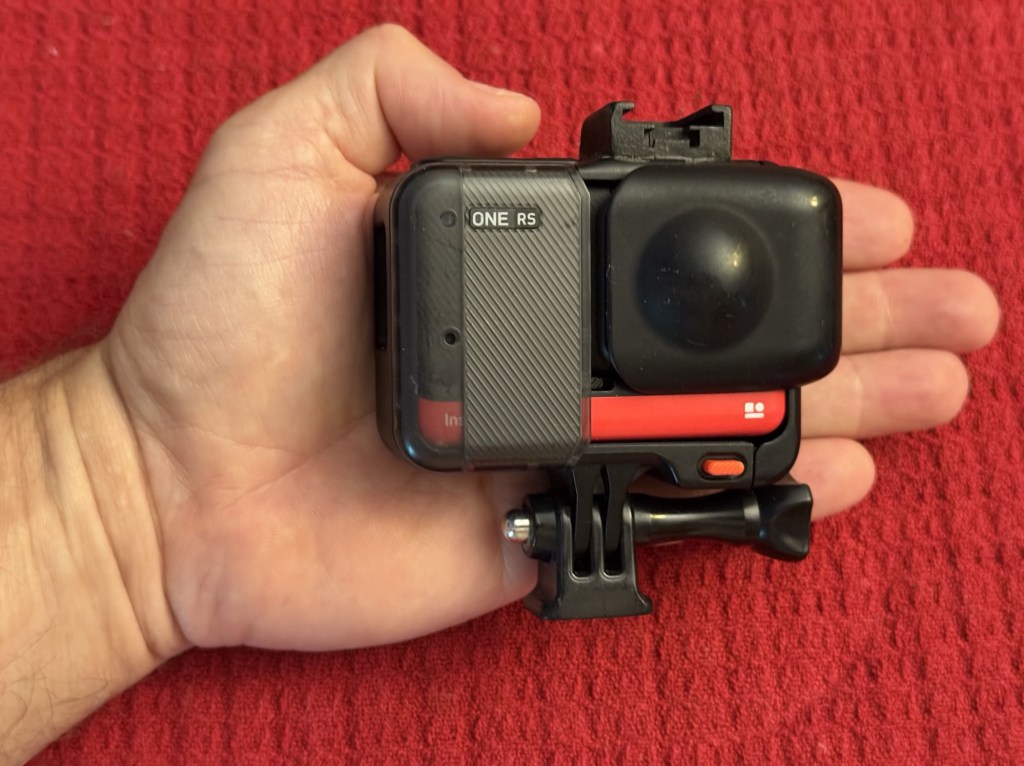
Secondly is intent. I’ve previously taken a SonyRX100 camera. Its combination of light weight and picture quality, combined with 10x optical zoom, is ideal. Its video quality is also very good BUT not while walking. For true video quality while hiking you need either a gimbal or a GoPro/Insta360/DJI type camera. I really wanted to capture video on this trip so I chose the Insta360 One RS camera with a 360 lens. It’s just the most versatile, lightest weight system I could find. What I give up with this is artistic quality still images. You cannot adjust depth of field with this system. Most still photos will be from my iPhone16Pro or Allison’s GooglePixel8
Thirdly is weight. I’m a self proclaimed gram weenie. (I weighed my safety pins used to hang clothes to dry to find the lightest ones.) To make the Insta360 really shine you need a selfie stick. They sell a good one but I just didn’t want the weight. I do however carry a walking pole. I “McGyver’d” my pole to attach a camera mount and I’m very happy with the result.
This set up allows me to take drone-like footage (the Insta360 software makes the stick disappear), it is 100% waterproof (you can take underwater shots down to 30’). It also charges quickly and takes common microSD cards for memory.
Where do you sleep, eat, go to the bathroom?
Where do we sleep?
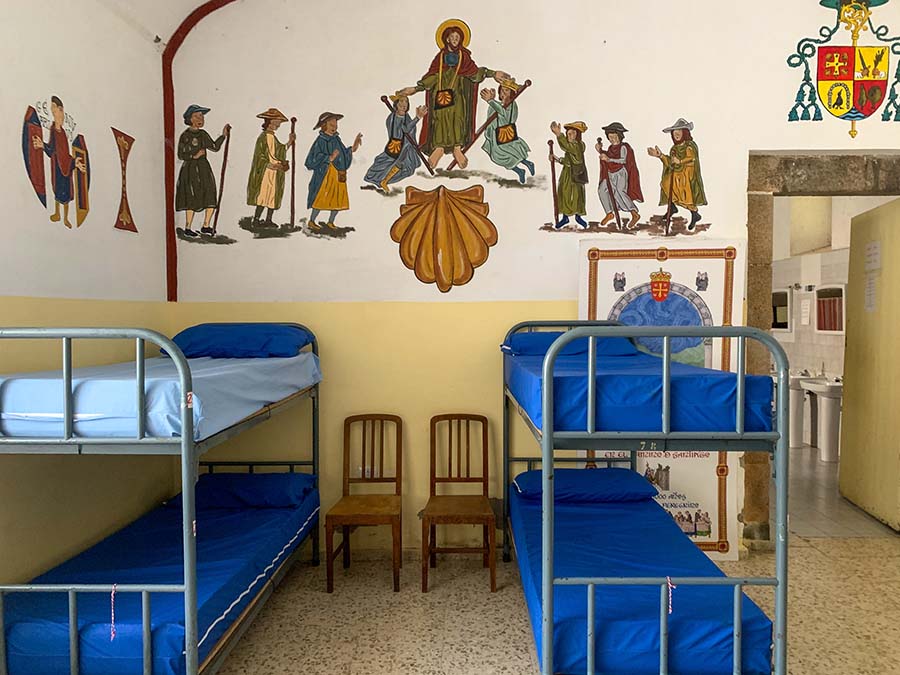
Anywhere actually. In Spain, there are a series of Albergues/Hostels that range from spartan to quite nice. They are run by private families, private organizations, or the local government. Your lodging is typically a form of simple bed or series of bunks (often 8 or more in a room). Only in the highest seasons or in some busy towns do you need to make reservations. You just show up and sign in.
Outside of Spain the infrastructure is much less complete. Your lodging may consist of a private business (small hotel, gite, B&B), a commercial hotel, a government sponsored Youth Hostel, or a religious institution (Monastery, Priory, Convent). Very often you need to book at least the day before your arrival. We also have brought a tent to take advantage of wild camping where allowed, or campsites to cut costs.
Some of the most unusual places we have slept are:
- The bell tower of a 14th century church
- The turret of a castle in France
- A crypt (two actually), one in Samos Spain and one in Switzerland
- A restored chicken coop in Italy
- Somewhere in the woods in central France
- A museum in southern France
- The home of someone who raised racing pigeons (who knew, right?).
Where do you Eat
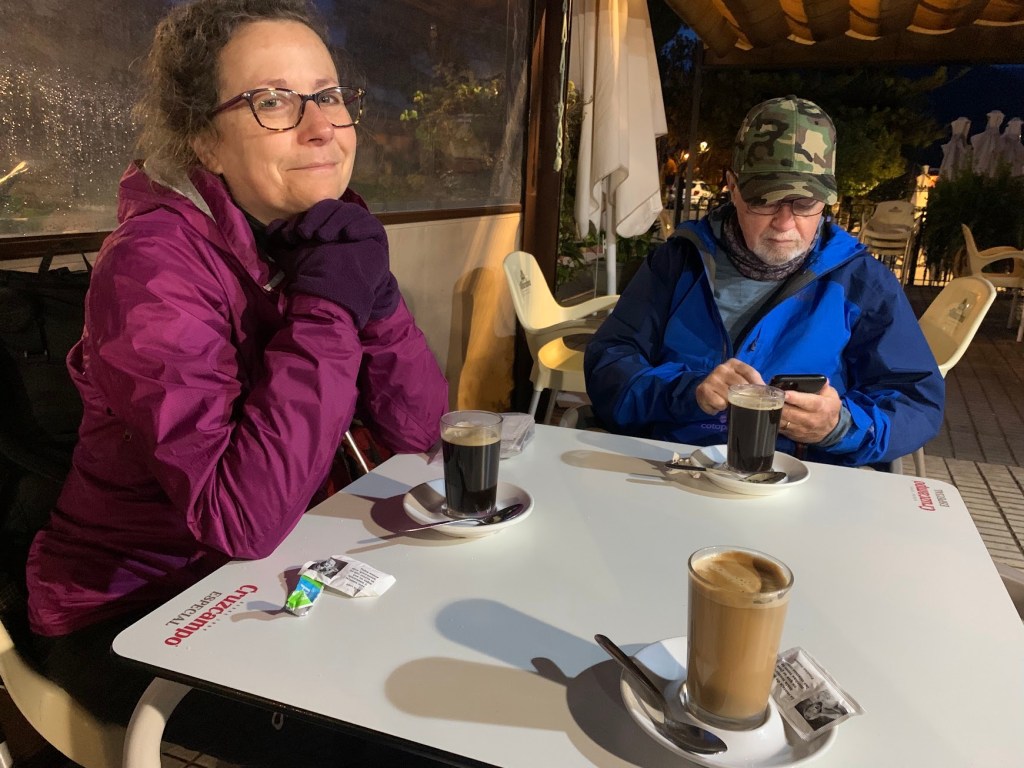
Breakfast is typically at the first cafe you come across in the morning. We normally have a coffee/tea and a sweet pastry, but occasionally get a larger breakfast with eggs.
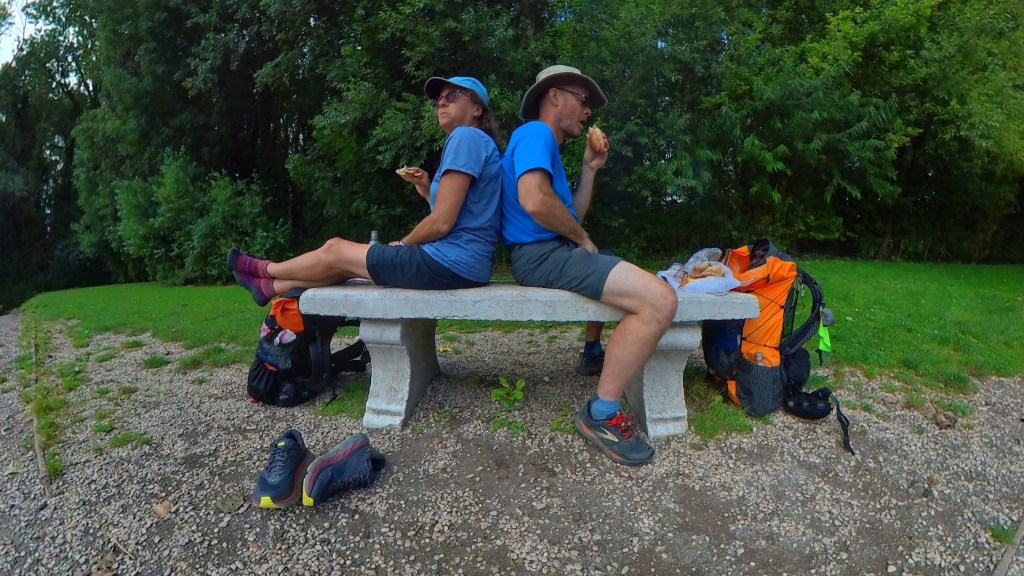
Lunch is almost always from groceries in our backpacks. We normally carry some bread, luncheon meat, a green pepper or avacado and some fruit. This is sometimes supplemented with tinned tuna, or pasta salad.
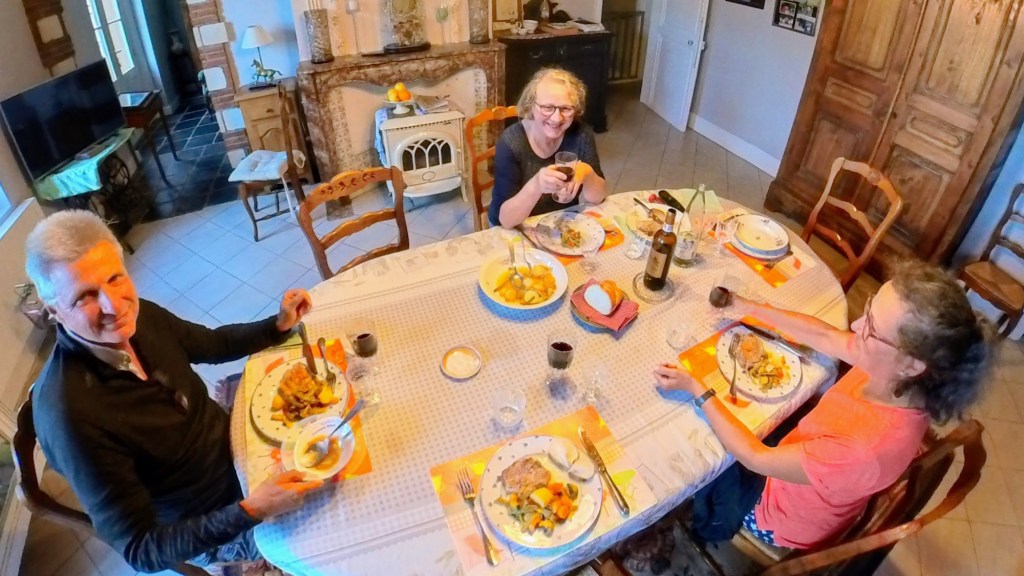
Dinner is normally either cooked at our site of lodging, offered freely from wonderful hosts, or taken at a local restaurant or cafe.
We rarely go hungry and trying local delicacies is one of the great adventures of pilgrimage. However there have been times (notably in 2021 during August in France in a Covid year) where we were often without food. We were never in danger of starvation but we did go hungry. Many many groceries were closed for either holiday or due to Covid.
Where do you go to the bathroom?
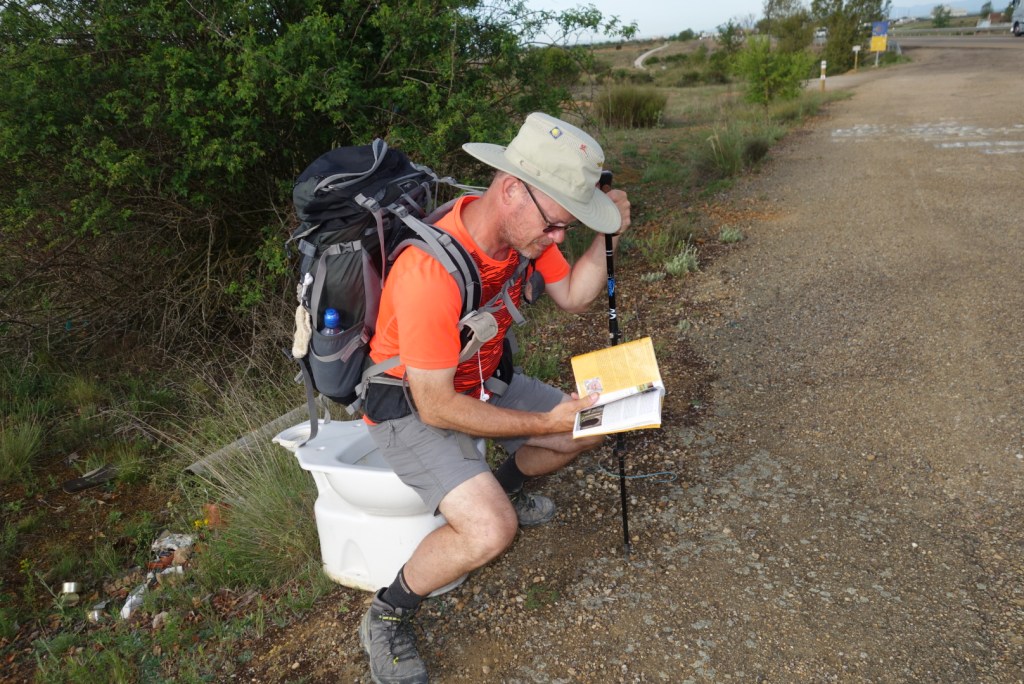
Well…very honestly, most of the time we will take advantage of a local cafe after purchasing a coffee. However as necessity demands, the local woods, behind a shrub, etc., are often called upon. You do what you have to!
Bring on your questions!
And I’ll see if I can answer them. :).
 OnceLostTrio